 THE GAME ARCHIVE
World War II: Panzer Claws (also known as Frontline Attack: War over Europe) is a real-time strategy game published by Topware Interactive; its Steam product date is 2013, and the store lists Windows, macOS, and Linux releases. The player takes control of the Allied, German, or Russian side across the battlefields of the Second World War. What separates the game from a pure tank-rush design is the weight it gives to infantry as a capture force, to engineering work such as minefields and pontoon bridges, and to a supply system in which ordered units and structures must physically reach a target point marked on the map. This feature explains those documented systems and the decisions they create, drawing on the publisher-supplied manual and the official store listing.
Infantry as the Capture Force
Infantry groups are the game's capture force. Any building free of enemy units can be used as shelter, and units hidden inside shoot more effectively because the building adds cover. Only infantry groups can capture factories and mines, which in Skirmish and Multiplayer produce a steady accumulation of funds. The same squads can take over an enemy vehicle once its crew is killed: the player mans the abandoned vehicle with his own troops and folds it into his army. Defensive constructions can be captured too, so a squad that clears a position can hand its structures over to friendly use. This makes infantry a tool for converting the map itself into income and shelter rather than a simple damage dealer.
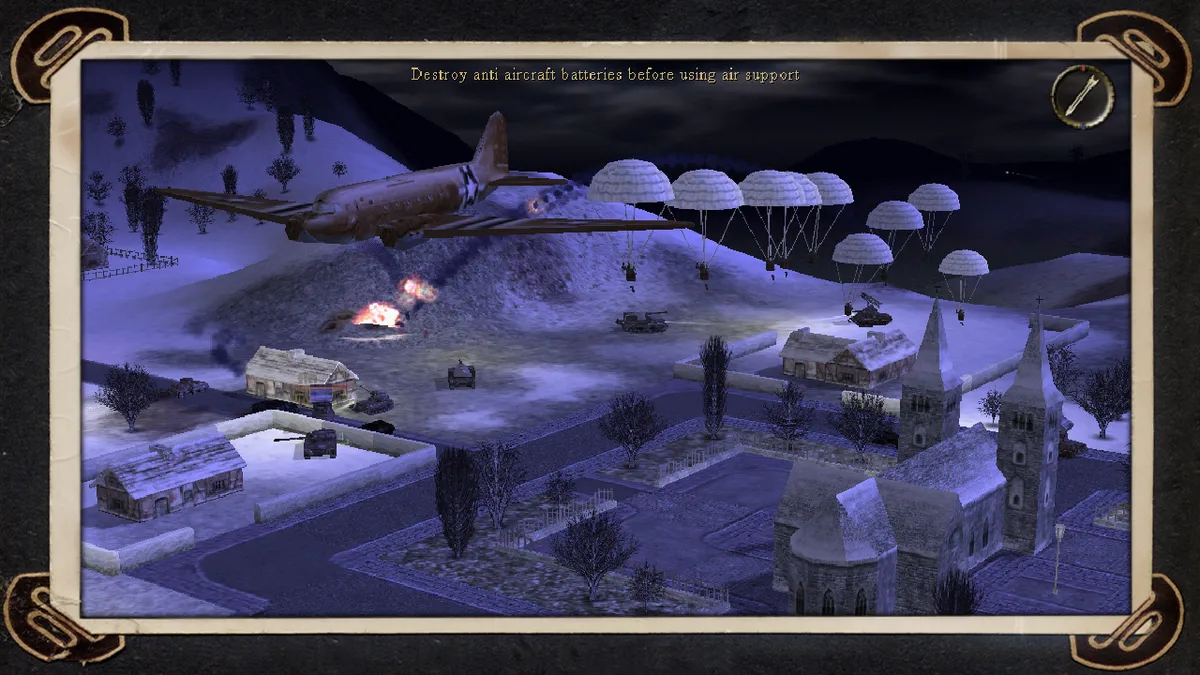
Capture work sits alongside the infantry's separate combat roles, and the manual treats those roles as the reason a squad is worth protecting. Anti-tank squads can destroy even the heaviest enemy tank, snipers use long-range guns to shoot enemy infantry from a distance, grenadiers are suited to destroying buildings and bunkers, and paratroopers, armed like assault infantry, can be dropped anywhere on the map to strike behind enemy lines. Basic rifle infantry has medium firing range and a low rate of fire, while assault infantry trades range for fast submachine-gun fire that is highly efficient at close quarters. The practical result is that the squad sent to seize a factory is not automatically the squad to hold it: a close-range assault group clears a building, while a longer-ranged or specialist unit covers the fighting around it.
Minefields, Pontoon Bridges, and Engineering
Mine-laying vehicles turn open ground into a defended zone, and the manual spells out the order sequence rather than leaving it abstract. After selecting a mine-laying vehicle, the player presses the minefield command and then selects an area of the map with the mouse cursor, confirming with the left mouse button. Dragging the cursor from a starting point lets the player mark a larger area for laying mines. Minefields are an efficient weapon against enemy units, and a player's own units pass through his own minefields without trouble, so placement can block approaches while friendly traffic keeps moving through the same ground.
Engineering vehicles handle two further construction tasks: pontoon bridges and anti-tank barricades. The construction commands sit under the Defensive Structures symbol in the order panel, where two additional icons enable them. Bridges let forces cross water; barricades provide a defensive barrier against vehicles. Because both come from the same engineering vehicle, one unit can serve either the movement problem or the defensive problem, and the player has to decide which the current front needs more.
Appearance Points and the Supply System
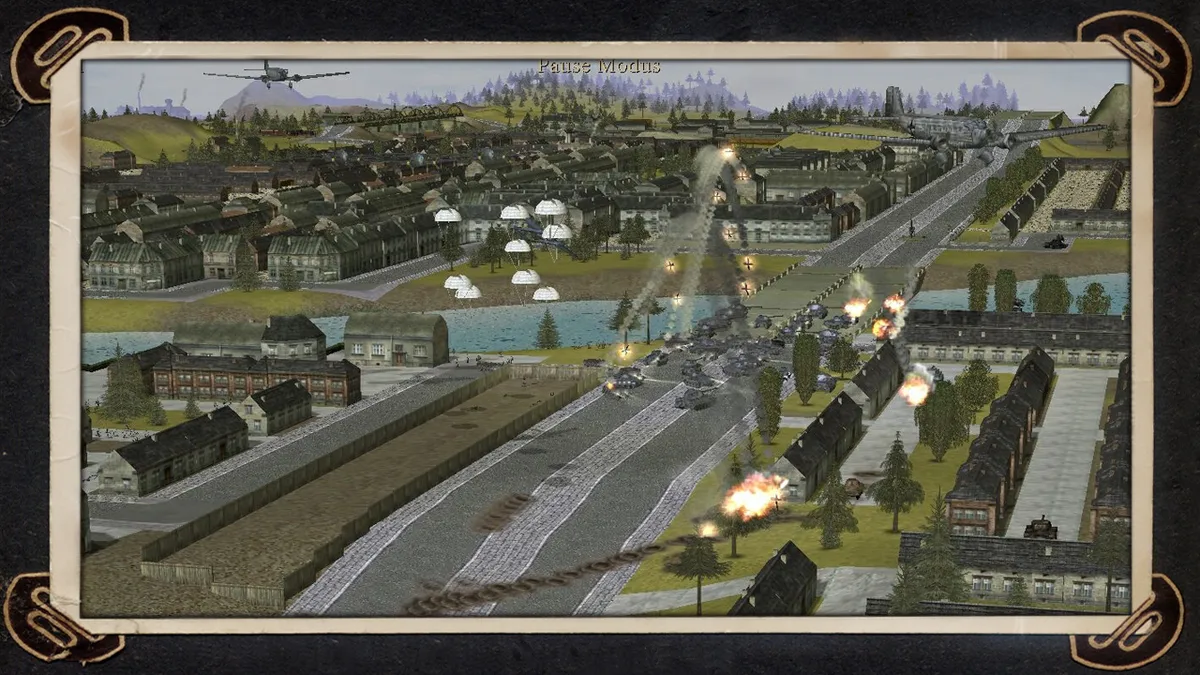
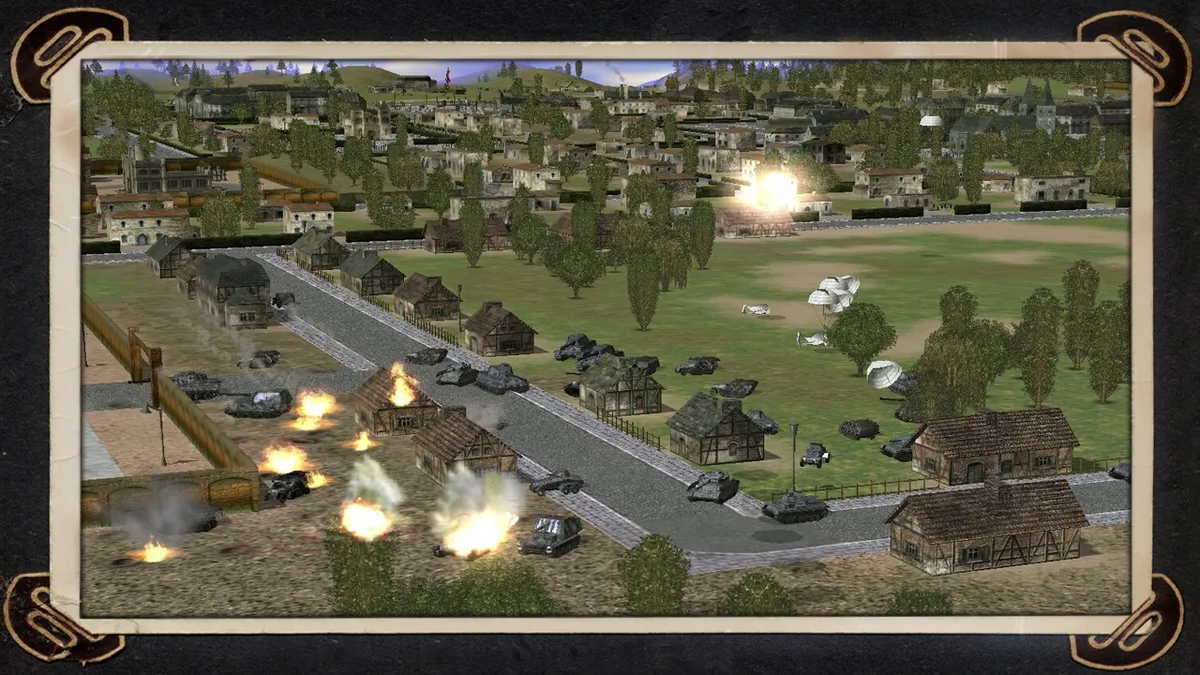
In Skirmish and Multiplayer, Panzer Claws uses a supply system modeled on combat conditions. Every ordered assault unit, base building and defense construction must reach a selected target point marked out on the map, so keeping supply routes open matters as much as a strong army or an extended base. Units and equipment enter the map through Appearance Points, which are often placed at the beginning of roads or transport routes and can be blocked or captured by players. In practice this turns logistics into a spatial problem: a player who builds a potent force still has to move that force into position along a route an opponent can contest.
Three kinds of Appearance Point appear on the map. An active point delivers arriving units and equipment on its own. A non-active point becomes operational when the player clicks it with the left mouse button at any moment. A neutral point goes to whichever player first moves a unit beneath it. Because ordered units and structures must travel to a chosen target point, blocking or seizing these entry nodes decides whether reinforcements and supplies can flow along the route, and a neutral point becomes a small race rather than a static marker.
Skirmish and SuperStorm Game Types
Skirmish mode lets the player define battle settings and fight engagements under the same combat conditions used in multiplayer, on suitable maps, as a way to build the experience and skills multiplayer requires. Maps created by the player in the editor are available within this mode. The start screen is laid out in four columns; the first lists available maps and lets the player choose the game type, since several game schemes exist. The manual also describes an easy-to-use editor for creating custom missions for single-player or multiplayer play, so a map made for practice can later carry a multiplayer mode.
SuperStorm Capture requires the player to capture every objective on the map (there may be one or more) and hold them for the time set in the Countdown Timer combo box, with a minimum of three minutes. Controls match SuperStorm Battle, and the map must carry a SuperStorm Capture designation. A player loses if all of his or her buildings are destroyed. SuperStorm Sniper, by contrast, can only be selected in multiplayer, and only weather options can be set in the Skirmish screen for it. Players score one point per human and one point per human unit killed using one of the two snipers; extra infantry arrive at a random place on the map as losses occur, and the game ends when one player shoots the others' snipers.
Anti-Tank Vehicles and Self-Propelled Howitzers
Armored countermeasures fall into two documented families: anti-tank vehicles and tank destroyers. The anti-tank roster names the Marder III, the Ferdinand, and the Jagdtiger, each assigned a specialized role in countering enemy armor. The tank destroyers are the M18 Hellcat and M36 Jackson, built around specialized weaponry meant to engage heavy enemy tanks. The Hellcat's manual notes that early American tank destroyers carried 37 or 57 mm cannons, judged inefficient against enemy armor, so a 76.2 mm gun was fitted to the T70 GMC in 1944 and the vehicle was renamed.
Long-range fire support comes from self-propelled howitzers, with the M7 Priest and M12 listed as available. The Priest is a 105 mm self-propelled howitzer, first built on the M3 tank construction and, in 1944, produced on the M4 Sherman chassis; together with its smaller companion, the Sexton, carrying an 87.5 mm gun, it formed part of the basic support equipment. These howitzers were mainly used for destroying defenses and fortifications, giving players a standoff tool against fixed positions rather than a direct-fire armor duel.
Resistance Operations and Partisan Recruitment
The manual's story material establishes the resistance frame before any mechanic is explained: in 1940 France fell, the French government capitulated and formed a collaborationist state, and resistance fighters took to the hills and back alleys to mobilize against their occupiers. Campaign play follows that arc. The player takes out enemy leadership, disables enemy infrastructure, deals with the retaliation that follows, recruits new members, helps rescue detained friends, and ultimately engages in a full-scale insurgent campaign that culminates in a daring escape. Victory therefore rests on objective-based play, captured and held locations, and mission-specific goals rather than on attrition alone.
Resistance work runs through named operatives rather than anonymous squads. November, also known as Nova Sommer, is a British agent serving the Special Operations Executive; she is the main link between the resistance groups under her control and Allied command in London, and she supplies precision intelligence that keeps forces moving in the right direction. Her combat profile is defined as heavy damage against humans, medium damage against pillboxes, light damage against tanks, and light defense, so she is not interchangeable with a front-line unit and must be kept alive through engagements.
Free French Partisans are recruited by meeting conditions on the map rather than by purchase. An unarmed partisan fighter typically waits for the player's help or for some critical action tied to the mission goals; when handled properly and given what is needed, that fighter will likely join the fight against the occupation. These unarmed figures deal no damage to tanks, humans, or pillboxes and carry only light defense. Once armed, a partisan wields a light machine gun and is used to secure areas and eliminate enemy soft targets.
Reading the Rules in Play
The documented rules point to a few concrete starting priorities. First, send infantry to contest factories and mines early, because only infantry can capture them and they are the documented source of steady funds in Skirmish and Multiplayer. Second, check your Appearance Points before committing a large order: several entry states exist, and an inactive or neutral point may need to be activated or raced for before reinforcements can flow. Third, when laying minefields, remember that your own units cross your own mines freely, which makes a mined approach a filter rather than an obstacle. Fourth, in SuperStorm Capture, treat the Countdown Timer as the mission clock: three minutes is the documented minimum hold time, and losing all buildings is a loss condition, so defending the base is part of holding the objectives.
Scroll sideways to see the full table →
| Item | Documented detail |
|---|---|
| Title | World War II: Panzer Claws (aka Frontline Attack: War over Europe) |
| Publisher | Topware Interactive |
| Steam product date | 2013 |
| Listed platforms | Windows, macOS, Linux |
| Playable sides | Allied, German, Russian |
| Appearance Point types | Active, non-active, neutral |
Sources & further reading.
- World War II: Panzer Claws — official game profileRetrieved Oct 29, 2026
- World War II: Panzer Claws — official game profile — publisher-supplied gameplay manualRetrieved Oct 29, 2026
First published .